Can
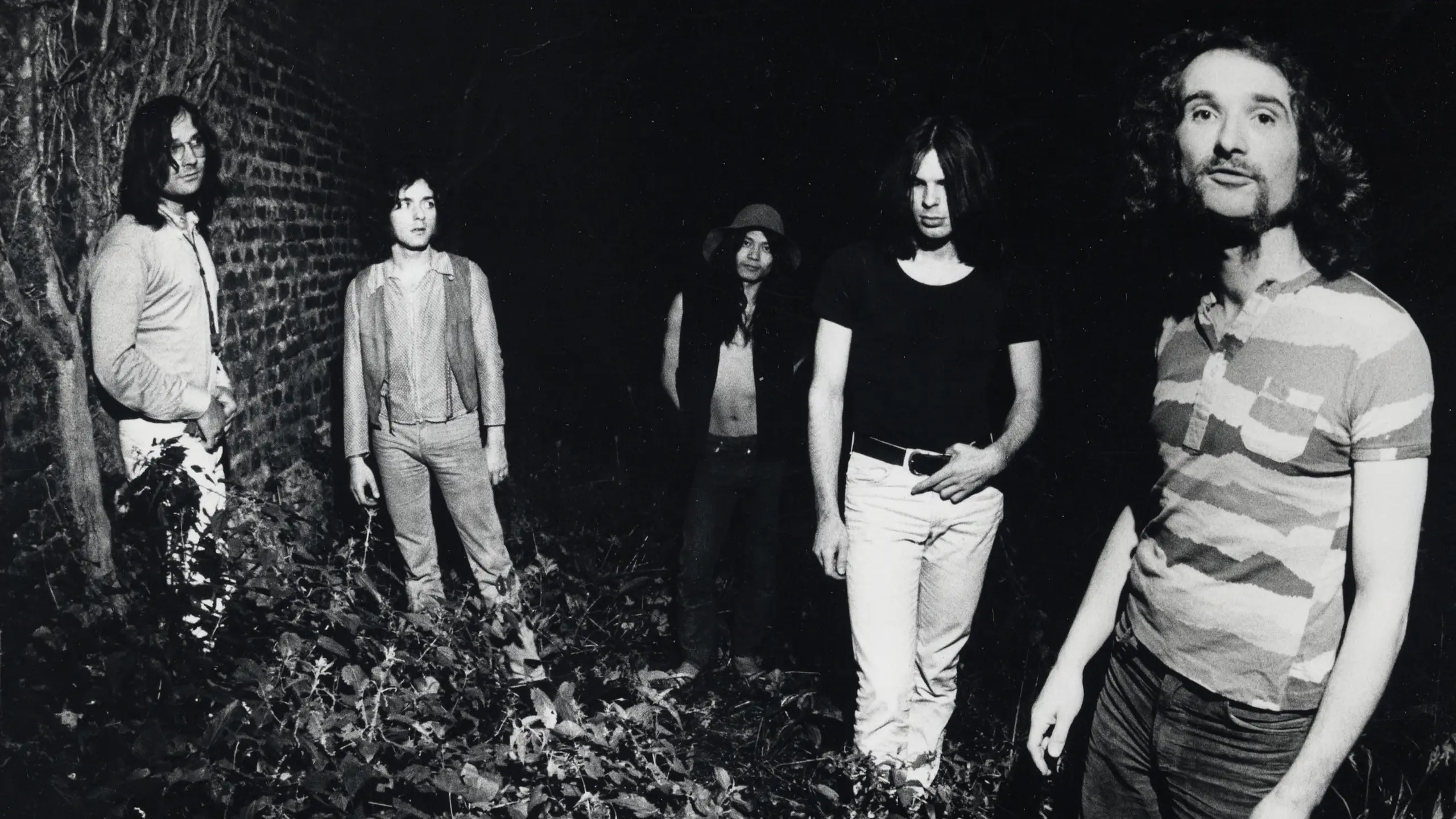
Can were a band from Germany. I love them more than words can describe.
Since its earliest days, when experiments could be tried and permitted to fail, Can has risen to the position of unassailable genius. It exists among a small pantheon of groups routinely cited by aspiring younger artists as influential, but also, critically, it is up there with the great innovators of post-war music, such as Karlheinz Stockhausen, Miles Davis, the Velvet Underground and Lee ‘Scratch’ Perry.[1]
They were experimental. They learned instruments and song theory and then threw it all away.
When they physically moved their studio some magnetic tapes were found. These were jam sessions. The tapes were cleaned up and issued as The Lost Tapes. This compilation is better than music by most bands a-sides; that says a lot about how much I dig Can.
If you're interested in Can, just listen to any of their music. I recommend Tago Mago, *Ege Bamyasi, Monster Movie, and Future Days to begin with.
For reading about Can, there's All Gates Open - The Story of Can by Rob Young. It's brilliant.
I think I first fell in love with Can when I heard the song 'Halleluwah'. To me, just the drumming on the track is mind-blowing. I seriously don't think I'll ever be able to wrap my head around the song. It kind of widens after a while. When it's pared with the wah-wah guitar and a metal flute, it just goes elsewhere. The song. The song! Can anybody decipher Damo Suzuki? Please don't. The bass.
This is clearly a 1970s track, but it transcends any kind of laziness and can always be rediscovered in a new way. That's great music to me.
Here's the song in two versions:
The studio version of 'Halleluwah'
A live version of 'Halleluwah'
Quotes from Rob Young's book
It sounds sophisticated in its digital, twenty-first-century urban garb, but the primal pulse underpinning it has energised humans’ ritual and celebratory musics for millennia. Being inside the music is supremely liberating, and there’s no way to escape it. That’s the feeling Can’s best music gives me. And I willingly submit to its paradoxical pleasures.
In the beginning, members were sucked into Can from disparate backgrounds in avant-garde composition, free jazz and rock ’n’ roll, all of them dissatisfied with what those genres could offer them at the end of the sixties. Can provided an opportunity to synthesize something new, building on the collective mindset learned in these different disciplines. Gates were kicked open whose previous existence was unknown. Jaki Liebezeit put it this way: ‘All the Can material I have done, I think you can see it’s never the same thing. On each tune I find some other rhythmical idea. I think it’s like astronomy: the further you get into it, the more stars you can see. If I lived a hundred years, I would never come to an end. I always discover new stuff.’
In one of our conversations, Holger expressed something that has been the key to my thinking about Can. ‘I thought it was like a living organism, Can: it had a beginning, it had a youth, it had a time getting old and a time to die. And out of it came all the members of Can who are still creative and never changed profession and became watch repairers or something like that. The strongest parts of Can were when they didn’t actually play – that means, when they got played, by a sort of secret machine behind it, ja? Then Can was really good. And that is when Can became an inhuman.’
On one occasion Irmin conducted the West German premiere of John Cage’s Atlas Eclipticalis for orchestra and performed Cage’s piano piece Winter Music. With Irmin acting as soloist and conducting the Bochum Symphony Orchestra from the piano, it was a night memorable for the confusion and conflict it caused. ‘There was the first clarinettist, who was a fan of any kind of avant-garde, and the second clarinettist, who was thinking, “It’s really shit.” These two clarinettists turned the whole performance into a war against each other. They played softly and they made their pauses. But when the first one made a tone, the second one tried to make a disharmony to it. And they created such attention that the whole orchestra listened to them and got into this mood of extreme attention, awareness … When I told Cage that, he loved it.’
Irmin was expelled from one school for exposing some of his teachers as former Nazis in the school newspaper.
But even as he was extracting odd, subaquatic sonorities from his percussion, Jaki was looking beyond the bubble he currently existed in. The fire at the heart of the most extreme free jazz had burnt itself out by the end of the sixties. ‘I was fed up, and I was afraid there was no real freedom in it, because it was so limited. Things like pulse were forbidden in jazz, so I was frustrated with free jazz, and I felt as a drummer you have to play some pulse and rhythm, and not always play around the rhythm like they did. Don’t play the direct rhythm, but just feel it and play around – I think that’s nonsense. So I came back to a kind of monotony in the beginning of Can.’
‘Oh, we played on anything,’ confirmed Michael. ‘A lot of the sounds we made come from bottles and saucepans and stamping on the floor, and it’s also a very important concept which I have also developed afterwards, is where to exactly place a microphone so that anything you hit or rub or blow into makes music. There is one point, if you bring the microphone there and find the point, you can play a whole symphony on a radiator.’
The lyrics are not easy to decipher, but it’s not fanciful to imagine them tangentially inspired by the sensory overload of Malcolm’s recent travels in the developing world, with lines such as: ‘You may drift there if you want to, luggage fits inside your pocket like a bill’; ‘Mother who in pain creating, woman who just lies there waiting’; ‘All has been forgotten and the plastic turns to rotten rays and smells’. Malcolm cycles around this rosary of vivid images that summon up impressions of the abject streets of a city like Bombay, and falls back on breathy abstraction (‘Heh-huh-uh-huh-euh’) in the middle, a vocal tic that would become a signature.
‘We couldn’t play,’ Holger admitted. ‘Now, if a band can’t play, if we had played rock ’n’ roll, it would have been ridiculous, so what can we do? We can do as if we were primitive native people from somewhere else, who are not able to play, but somehow being musical. And that was it. It was combined with a lot of humour during the recording. Jaki, for example, took a clarinet. He mixed the mouthpiece of a clarinet together with a flute. He combined this together and played. Fantastic!
It’s on ‘Yoo Doo Right’ that you can hear Holger crawling inside the beat in a new way. ‘Jaki … always told me I would never get rhythm, but I thought, what does he know? He’s just a stupid drummer!’ Holger said in a later interview. ‘But he was right and Jaki is one person whose criticism I take to heart. Jaki always demands a drummer to play as simple as possible, that he should invest all his musicianship into the infrasound, that essential in the music which is beyond the note itself. ‘Today we have so many good, functional drummers, guitar players, all of them interchangeable, all sounding the same. For they do not possess that indefinable quality. Jaki has that. He made me understand rhythm is the greatest concentration of music, that one single drum beat can contain all the music in the world.’
So it was Damo’s eccentric screams that caught the attention of Holger and Jaki as they sat outside a Munich bar in May 1970, round the corner from the Blow Up club, where they were beginning a four-night residency with a sold-out show. Holger remembered the moment: ‘I was sitting with Jaki in a café and Damo came along and he was making an incantation to the sun or something strange like that. I said, “Jaki, this man will be our new singer.” He said, “Come on, are you being serious? You haven’t even heard him and you say that?” So I went to Damo and said, “What are your plans for tonight?” He said, “Nothing.” So I said, “Do you want to be a singer in a band for a sold out concert?”’
‘Before,’ Michael said of Jaki, ‘I hadn’t really understood him. During the recording of “Halleluwah”, I suddenly understood Jaki’s greatness, the direct effect that he has on the associative centres of the brain. All you hear is a drum kit. But celestial choirs line up behind it. That happened to me during the editing work on the rhythm tapes.’
I began picking up on Can in the very late eighties, a time when little of the back catalogue was easily available in shops. In the music press, Can began to be a name dropped with increasing frequency by artists in both the indie-rock and acid-house/techno sectors. Then came the release of Rite Time in 1989, and the band itself emerged briefly back in the spotlight. That was surprisingly good timing. Loop, the British guitar group, recorded a monolithic, nerve-shredding cover of ‘Mother Sky’, complete with explosions, on their 1989 EP Black Sun. Credible alternative figures such as Julian Cope and Genesis P-Orridge became more vocal cheerleaders of German rock, and Bobby Gillespie of Primal Scream often mentioned Can as one of his favourite groups. The 1997 Primal Scream single ‘Kowalski’ sampled drums from ‘Halleluwah’, and Jaki Liebezeit eventually guested, uncredited, on their XTRMNTR album of 2000. The spaciousness, rhythmic delicacy, near-inaudible lyrics and sonic experimentation of Talk Talk’s farewell album Laughing Stock (1991) owed a big debt to Can’s sound. Stereolab’s Farfisa-driven metronomic rock, with sloganeering lyrics that harked back to a pseudo-1968 sensibility, helped turn younger listeners on to the historic motorik of Neu! and Can. Their Chicago-based contemporaries, the instrumental group Tortoise, concocted a mix of surging polyrhythms, egoless soloing, electronics and electric guitars, bred from a similar hothouse of jazz, rock and avantgarde sensibility. Meanwhile, in New York James Murphy of the US group LCD Soundsystem wore a Future Days T-shirt on stage and in photo shoots; the group deployed the meta-consciousness of Can even as it delivered seductive and overwhelmingly infectious rhythmic heft.
Can continues to reach a wider public through the medium of cinema. The films Can soundtracked in its early years were mostly obscure cult movies and porn flicks. Recently, more mainstream music editors have included Can tracks in various cinema releases: Broken Embraces, Norwegian Wood, The Bling Ring, Inherent Vice, Life After Beth, High Rise. In Germany ‘She Brings the Rain’ was placed in both Wim Wenders’s Lisbon Story (1994) and Oskar Roehler’s Die Unberühbare (2000), while Can music was used to brilliant, jarring effect in a BBC documentary on the Baader-Meinhof group, In Love with Terror, in 2002. Jonny Greenwood, guitarist in Radiohead and accomplished soundtrack composer, selected the Can tracks in Norwegian Wood (Tran Anh Hung, 2010) and Inherent Vice (Paul Thomas Anderson, 2015). Radiohead (as well as John Frusciante of the Red Hot Chili Peppers) have been one of the highest-profile champions of Can’s music, often including a cover of ‘The Thief’ in their live sets, and throughout Radiohead’s international tour of 2017 their rhythm section – two drummers and a bassist – sounded markedly Can-like in its mechanised discipline. The Scottish author Alan Warner has dedicated novels to Holger Czukay and Michael Karoli, and Lynne Ramsay’s 2002 film adaptation of Warner’s book Morvern Callar featured two Can tunes, as well as a couple by Holger Czukay. (Warner even published a short book on Tago Mago in 2015.
JA: Jesus …! At Einstürzende Neubauten concerts, for a time, bottles and cans were regularly thrown on the stage. It was often quite dangerous. I wasn’t the guitarist yet at the time, but we were friends. I saw it from the audience. That was exciting. You also always had to be careful in the audience. You were always nervous that something would come flying at you or a fire would break out. N. U. Unruh, one of the two steel drummers of the Neubauten, was a bit of a pyromaniac. He lit fires on the stage. It got really hot. You couldn’t really relax at those concerts. But it was never boring.
IS: Hildegard, as our manager, would handle all the money and all our business affairs. She’d split up the dough equally among the band members. To the exact pfennig. In all the years we never had a discussion about who’d written which melody or bassline, or who’d written the lyrics. And this even counted for songs like ‘She Brings the Rain’, in which Jaki and I don’t even play. Jaki always said, ‘Not playing was my contribution to this song.’
Quotes from Christoph Dallach's book 'Neu Klang'
IRMIN SCHMIDT We experienced jazz in all its diversity and history, as a genuine twentieth-century artform. That was really important for Can's conception, partly because it meant something already existed, where no one could say - like they always say in Germany - this thing is great art and that thing is light entertainment. For me, jazz was part of what was new in the twentieth century, just like Neue Musik. In a way, jazz was a newer kind of music than Stockhausen. With Stockhausen's works, you can trace the family tree back to the Tristan chord. It's a European tradition, and it leads to Stockhausen or Boulez. The incursion of jazz was very different; it didn't come out of our history in Western culture. The only link was the slave trade, through which African music was transported to America. And the result was entirely new forms of music: jazz, rock and blues - all that was entirely new in the Western world. I had a deeply held feeling that I wanted to integrate these genres into my musical consciousness. And the same way as I'd internalised it, I wanted to experience it for real in music, to do it myself, start a band where it all played a role. The idea of the spontaneous and everything together was more of an ideological aspect that I added to it all.
HOLGER CZUKAY It was always clear to me that there'd be no getting around music, in my life. But I soon realised that jazz wasn't my language. I even won prizes for jazz, but it still wasn't my language. Listening to Stockhausen on the radio in bed at night - that was it! I loved it, it was crazy! That's when I noticed he had something. I found that out when I was still at school. Stockhausen got a lot of joy out of shocking people, musically. Then after I'd met Stockhausen, I once saw someone call him out: 'Herr Stockhausen, all you want to do is shock your audience and make a lot of money out of it.' He replied: 'I can promise you I'm acting purely out of musical motivation. And when it comes to money, I don't need to worry because I married a rich woman.' That got all my bells ringing - it was right up my street! Exactly what I wanted to do too! When I had to make a living after university, it was a matter of finding a rich woman - so I moved to the homeland of rich women: Switzerland. And I picked a boarding school where the richest of the rich sent their children. I applied for a job as a music teacher there, and when the headmaster asked me about my training and my teaching qualifications, I proudly answered that I'd studied under Stockhausen. The headmaster had no idea who he was but he still gave me the job. But instead of a rich woman, in the first class I taught I met my student Michael Karoli. He was eighteen, in the upper sixth.
HOLGER CZUKAY I learned from Stockhausen that music is something absolute. Before I started my degree, I went to Stockhausen and said:
'Herr Stockhausen, I can't play anything.' 'What do you want to be?'
'A composer!' He gave me a long, hard look. 'All right, I'll take you.'
Schmidt only came to Stockhausen later. In the year when Schmidt came to us, Stockhausen took me aside once and said: 'Czukay, you think too much. You ask too many questions of music. You can barely compose because you're always asking questions. I've been at that point in my life too, asking myself so many questions that I couldn't compose. Only a few come up against that wall, but that's all the more reason for you to jump over it! No matter where you land afterwards.'
It made me cry for a moment. He'd spoken to me man to man. A year later, he said: 'When a bird's ready to fly the nest, it spreads its wings: off you go!' And that's how I ended up in Can.
HILDEGARD SCHMIDT The key thing was that everyone played an equal part in the music. There's not one who writes the lyrics and one who composes the music. Everyone was always involved in everything. Always! Always! Always!
RENÉ TINNER We really went to the studio every day, except when we were on tour. Either way, we were making music every day. The pleasant thing was that we were never under time pressure because it was our own studio. Sometimes we worked right through two days and nights, there was no time for sleep. And everything was always recorded. The Can philosophy was: the red light has to be on from the moment you walk into the studio, otherwise you might as well stay at home. You can't throw away what you haven't got. The usual process was to do only recording for four or five days. Then we set it aside. After a week or so we'd listen to it and see whether this or that section might be interesting. But it was all very free. And everyone almost always agreed on what was good and what wasn't.
HOLGER CZUKAY At the beginning I always wanted to play as many notes as possible. But Jaki said to me: 'Holger, just play a single note now and then.' So I tried it, and the result really was very interesting. That's how I realised I had to reduce things. It was actually the first elementary music lesson I ever got: the important thing is not to play as much as possible, but to let the others get a word in too. And even with just one bass note, you can make a big impression. Realisations like that were more important to me than any politics.
HOLGER CZUKAY I saw Damo on Leopoldstrasse in München and I said straight away: 'Jaki, he's going to be our next singer!' That was typical of me. I like to decide things like that intuitively. Damo was just sitting on the street and worshipping the sun. Jaki was horrified: 'Holger! You don't even know the guy!' But I'd already got up and gone over to Damo. I said to him: 'Hello, I'm Holger. What are you doing tonight?' He said: 'Nothing.' 'Do you want to be a singer?' 'Yeah, why not? I've got nothing else to do right now. What do I have to rehearse?' 'Rehearse? Nope. You've got to dive right in.' 'OK, why not?' The place we were appearing that night was packed to the rafters. Damo started very gently, sort of Japanese. But then he got really aggressive all of a sudden, samurai-like, at the touch of a button. He screamed and yelled blue murder. And we reacted to it. The success was marked by a huge punch-up in the audience. I thought it was all incredibly funny. After a while the place was empty, but we just kept on playing. It wasn't a rock concert any more, it was a happening. The people running away was part of the performance - we saw it as a triumph.
HOLGER CZUKAY Lyrics were a necessary evil. That was how I felt, in any case. Damo was at his best as a singer when he used his imaginary Japanese. It really worked perfectly. Voices were instruments for us, be it Malcolm Mooney, Damo Suzuki or Irmin Schmidt now and then. In that respect, we were like Joy Division: the band didn't care what the singer thought.
NIKEL PALLAT At Can gigs, the monotony produced a kind of inner peace. Not like Amon Düül, who flipped out much more on stage. Can was trance, Amon Düül was ecstasy. But they were both excellent bands.
HOLGER CZUKAY When we didn't find a singer for a while, I suggested we could just have the radio playing instead. I got everything ready one day to synchronise it, but the others didn't like the idea. I asked: 'Why? It's the original Can concept!' After that I knew my time with Can was nearing its end. Which was painful, of course.
From All Gates Open - The Story of Can by Rob Young. ↩︎